Knowing how to act in the first minutes of an emergency can make all the difference until professional help arrives. A first aid course teaches, in a practical and accessible way, how to recognise risks, give initial emergency care and avoid actions that could make things worse. With a few well-organised lessons, you can gain confidence to deal with accidents at home, at work, at school or in public places.
Why learn first aid in a few lessons?
Learning first aid in a few lessons is possible because the focus is on the essential steps: assessing the scene, protecting the casualty, calling the emergency services and applying basic techniques calmly. The aim is not to turn the student into a health professional, but to prepare them to respond better in common situations, such as choking, falls, cuts, burns, fainting and seizures.
Many people only look for this knowledge after witnessing an accident. The problem is that, in a real emergency, improvising increases fear and can delay important decisions. A well-run first aid lesson helps the student understand what to do, what not to do and when to call for help immediately.
It is also worth remembering that this learning is not only for major accidents. It is useful in everyday life: a child who gets hurt playing, a colleague who feels unwell at work, an older relative who has a fall, or someone who chokes during a meal. At those moments, having a simple mental script reduces panic and improves the response.
What good first-aid training should teach
Good first-aid training combines clear theory with supervised practice. It is not enough to memorise the names of procedures; the student needs to understand the logic behind the actions. First comes scene safety. Then assessing the casualty. Next, calling the right help and carrying out the basic manoeuvres when they are indicated.
Among the most important subjects are:
- Initial assessment: looking for hazards in the environment, checking whether the casualty responds and identifying signs of severity.
- Calling for help: knowing when to call the emergency services and what information to give.
- Choking: learning the right manoeuvres for adults, children and babies, respecting each age group.
- Bleeding and wounds: controlling bleeding, protecting cuts and avoiding contamination.
- Burns: cooling correctly, protecting the affected area and avoiding dangerous home remedies.
- Fainting and sudden illness: positioning the person safely, watching for signs and not offering food or drink without guidance.
- Seizures: protecting the casualty from knocks, not putting objects in their mouth and waiting attentively for the seizure to pass.
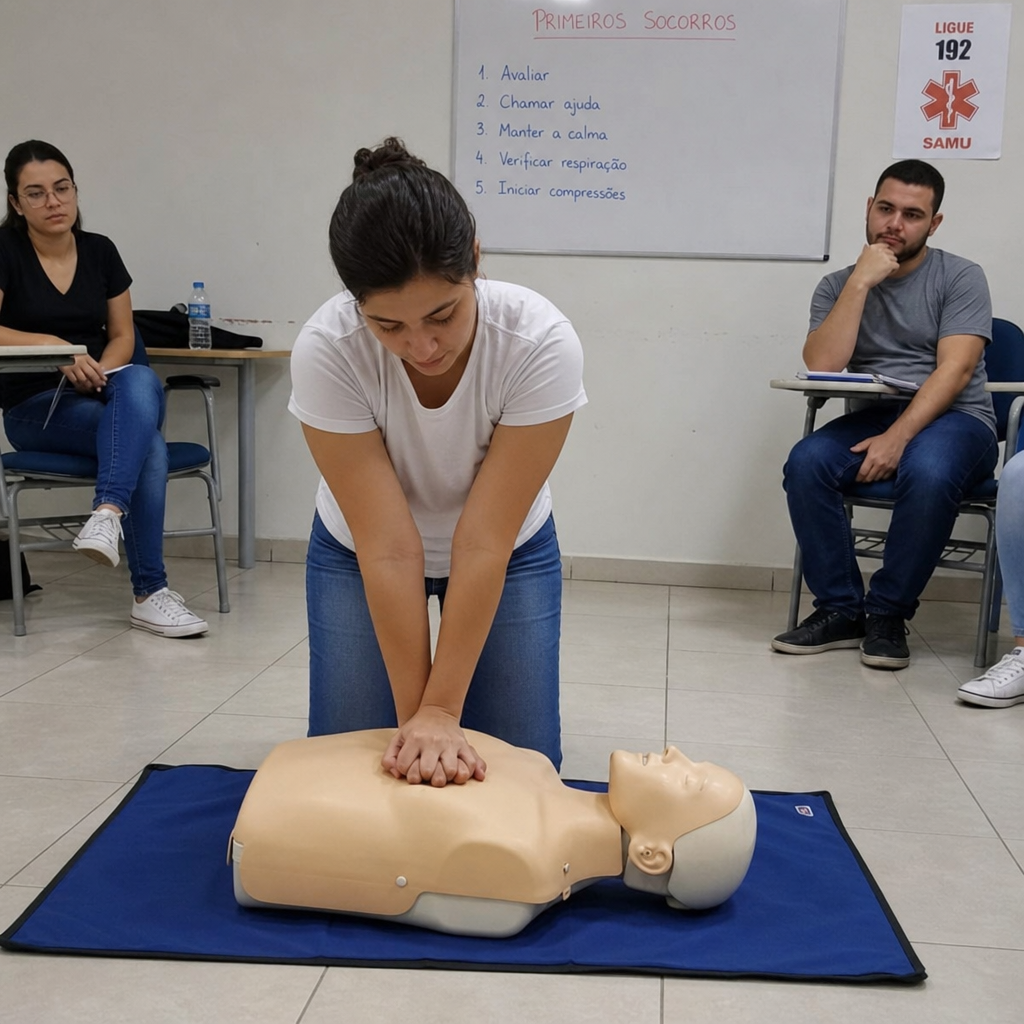
- Cardiac arrest: recognising the warning signs and understanding the basic principles of resuscitation — which is what a Basic Life Support course covers in depth.
These subjects make the learning applicable. Students leave with a real grasp of emergency care, knowing that their role is to give initial support, keep everyone safe and make the professionals' work easier when they arrive.
In-person or online first aid course?
The choice depends on your routine, your goal and the kind of skill you want to develop. An online first aid course can be a good starting point for understanding concepts, reviewing procedures and studying at your own pace. An in-person course tends to be more suitable when there is practice of manoeuvres, simulations and correction of posture by instructors.
For many people, the ideal format combines the two. The online part presents the fundamentals and common situations; the practical class reinforces movements, the sequence of care and decision-making. This combination is especially useful for anyone who wants to gain confidence, because watching an explanation is different from practising a response under guidance.
Before choosing, look at a few points:
- Syllabus: check that the course covers common emergencies and situations relevant to your life.
- Practical hours: where manual techniques are involved, look for classes with demonstration and practice.
- Accessible language: the material should be clear to laypeople, without an excess of technical terms.
- Up-to-date guidance: protocols can change, so the content needs to follow current recommendations.
- Certificate or proof of completion: if you need the course for work, an internship or an institutional requirement, check in advance which requirements are accepted.
Most important of all is to avoid a false sense of preparedness. A good emergency course makes clear the limits of what a lay first-aider can do and stresses that professional help must be called whenever necessary.
Why a paediatric first aid course matters
A paediatric first aid course deserves special attention because babies and children are not "small adults". The body, communication and risks change with age. Choking, falls, high fever, cuts, accidental poisoning and accidents at home call for careful responses suited to the child's development.
Parents, grandparents, carers, teachers and professionals who work with children benefit greatly from this kind of training. Beyond the techniques, the learning helps create safer environments. Many emergencies can be prevented: storing cleaning products correctly, watching out for small objects, supervising meals, covering sockets, taking care around swimming pools and organising play areas.
A good paediatric first aid course usually covers:
- preventing accidents at home and at school;
- choking in babies and children;
- falls and knocks;
- burns from hot liquids or surfaces;
- fever, febrile seizures and warning signs;
- poisoning and contact with dangerous substances;
- when to seek urgent medical care.
This knowledge brings peace of mind without encouraging overconfidence. The idea is to act quickly, but also to recognise when a situation calls for immediate referral.
How to get the most out of each first aid lesson
To really learn, take an active part. Ask questions, ask for examples and relate the content to your own context: your home, your work, your school, your daily commute. The more concrete the learning, the easier it will be to remember the steps in moments of tension.
During the course, a few simple habits help:
- write down the emergency numbers and keep them to hand;
- review the main procedures after each lesson;
- practise the mental sequence: safety, assessment, calling for help and initial support;
- put together or update a basic first-aid kit;
- share prevention tips with family or colleagues;
- retake the training regularly so as not to forget important steps.
It also helps to think about likely scenarios. Someone who works in an office might focus on sudden illness, falls and choking. Someone who looks after children needs to reinforce prevention, choking and accidents at home. Someone who plays sport should pay attention to injuries, bleeding and falls. The same course can be used in different ways depending on each student's life.
Safety starts before the emergency
First aid is not only a reaction; it is also prevention. After a first aid course, many people start noticing risks that used to seem invisible: loose rugs, exposed cables, sharp objects within children's reach, unlabelled toxic products, spaces without signs or incomplete kits.
This change in outlook is one of the greatest benefits of the training. When you learn how accidents happen, you can reduce the chance that they occur. And if they do, you are clearer about how to stay calm, protect the casualty and get the right help.
First aid courses at the Brazilian Red Cross — Rio de Janeiro Branch
If you have read this far, the next step is to put it into practice. The Brazilian Red Cross — Rio de Janeiro Branch offers in-person courses for people who want to move beyond theory and really practise, with instructors and realistic simulations. They are taught in Portuguese, at the branch headquarters in central Rio de Janeiro:
- Basic First Aid (8 hours) — the essential content of this article, in practice.
- First Aid under the Lucas Law — Settings with Children (8 hours) — for people who work or live with children, and required by law in Brazilian schools and children's settings.
- Basic Life Support (4 hours) — focused on recognising cardiac arrest and resuscitation.
First published in Portuguese on 21 September 2026. Read the original →