
Basic Life Support (BLS) is the set of initial actions taken in a serious emergency: recognising that the person is at risk, calling for help, starting cardiopulmonary resuscitation when needed and using an automated external defibrillator (AED) until specialised help arrives. A basic life support course is short and focused, designed to fit into a working routine, with a direct impact on the safety of the people around you.
BLS, first aid and advanced life support: where each begins
The three terms appear together, but they are not synonyms:
- First aid: a broad concept, covering initial care in any situation, such as cuts, burns, falls and fainting.
- Basic Life Support: a specific part of first aid, focused on situations that are immediately life-threatening, such as cardiac arrest and severe choking. The tools are your hands (CPR) and the AED.
- Advanced Life Support: provided by health teams, with specific equipment and medicines. In Brazil's SAMU ambulance service, this is the work of the advanced support ambulances, which carry a doctor and a nurse.
BLS is the bridge between the moment of the emergency and advanced support. The sooner it starts, the better the chances for the person being helped.
The chain of survival
The American Heart Association, one of the leading international authorities on resuscitation, describes the response to cardiac arrest as a chain of survival, a sequence of links that depend on one another. In the 2025 guidelines there are six: recognising the arrest and calling for help, starting CPR immediately, defibrillating as soon as possible, receiving advanced support, post-arrest care and recovery. BLS covers precisely the first links — the ones that happen before the health team arrives and that are usually in the hands of whoever is nearby.
Can a layperson use an AED?
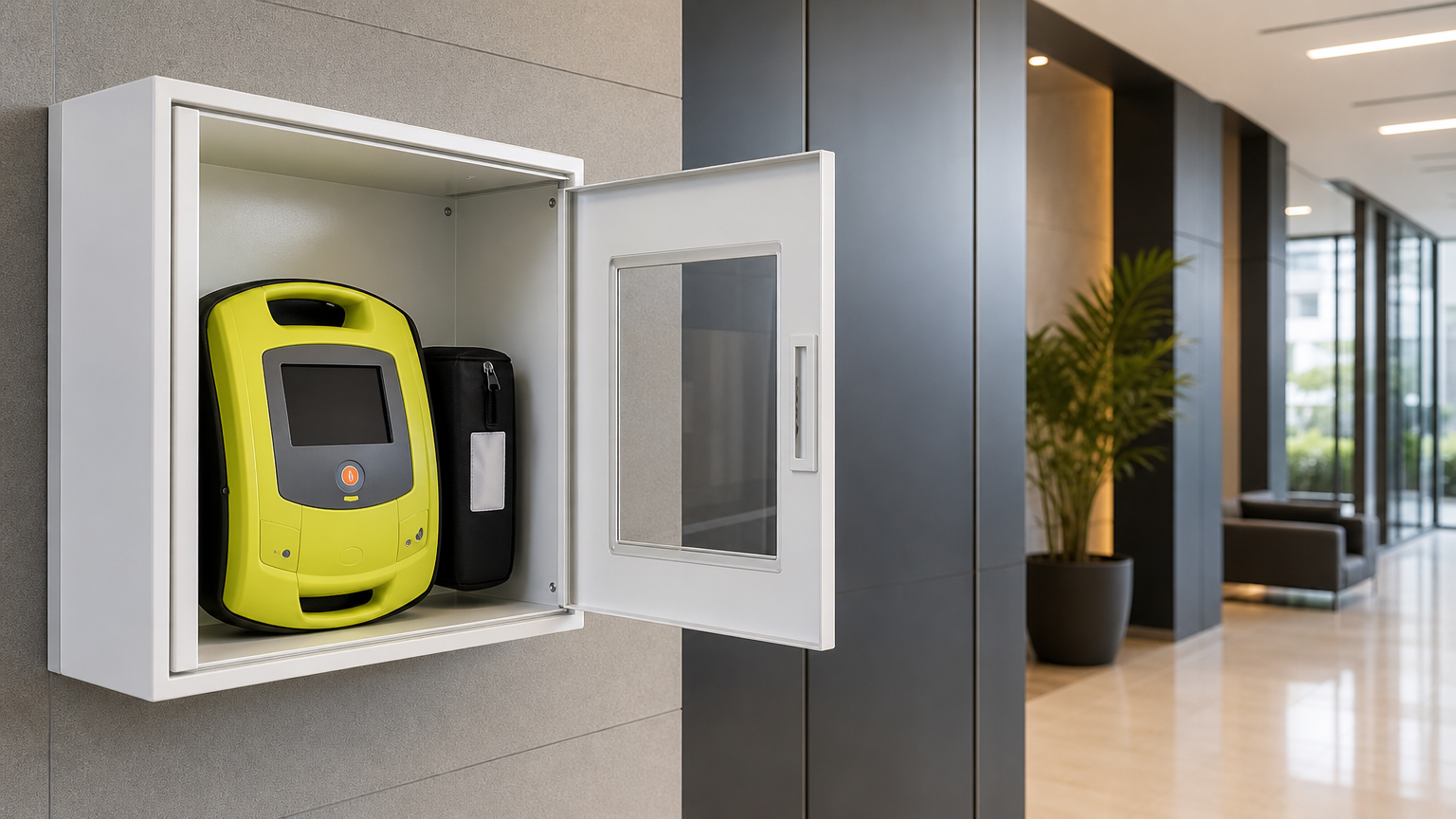
Yes, and the device was designed for that. An automated external defibrillator gives voice instructions, analyses the heart rhythm by itself and only delivers a shock when one is indicated. AEDs are increasingly common in shopping centres, airports, stations, gyms and companies. What is often missing is someone with the confidence to fetch one and use it — and that is what the training solves.
Training designed for the workplace
Companies, schools, gyms, residential buildings and security teams occasionally face medical emergencies on their own premises. Having part of the team trained in BLS shortens the time between the start of the emergency and the first correct response, and settles who calls 192, who fetches the AED and who starts resuscitation, instead of everyone waiting for someone else to take the initiative. In places with a fire brigade or civil firefighters, BLS strengthens the response to medical emergencies.
What the course teaches
In a direct format, the course covers:
- Assessing casualties
- Cardiopulmonary resuscitation (CPR)
- Using the automated external defibrillator (AED)
- Bleeding control
- Trauma care
- Procedures for choking and fainting
- Other urgent situations
At 4 hours, combining theory and practice, it is one of the quickest ways to bring this training to a whole team with little impact on the routine.
Why companies and professionals look for this training
Health, education, security and the corporate world in general benefit from having professionals trained in BLS, both out of responsibility for the people in their care and because, in many contexts, it is valued in hiring. It is also an accessible course for anyone who simply wants to be prepared, with no professional aim.
The course at the Brazilian Red Cross — Rio de Janeiro Branch
The branch's Escola de Educação e Saúde CVB-RJ (School of Education and Health) runs the Basic Life Support (BLS) course:
- Hours: 4
- Minimum schooling: completed lower secondary (ensino fundamental)
- Format: in person, combining theory and practice
- Language: Portuguese — there is no interpreting or group in another language
- Who it is for: professionals in health, education, security, companies and anyone interested
- Certificate: issued by the Brazilian Red Cross — Rio de Janeiro Branch
Frequently asked questions
What is the difference between BLS and first aid? First aid is a broad concept, covering any initial care. BLS is the part focused on immediately life-threatening emergencies, such as cardiac arrest and severe choking. At the school, the BLS course and Basic First Aid cover the same subjects; what changes is the length: 4 hours for BLS and 8 hours for Basic First Aid.
What is the difference between Basic and Advanced Life Support? BLS can be given by anyone trained, with their hands and an AED. Advanced Life Support is provided by health teams, with specific equipment and medicines.
Can someone with no health background use an AED? Yes. The device gives voice instructions, analyses the heart rhythm and only delivers a shock when one is indicated. The training gives you the confidence to use it without hesitating.
What is the chain of survival? It is the sequence of steps that improves the chances of someone in cardiac arrest. In the American Heart Association's 2025 guidelines there are six: recognising the arrest and calling for help, starting CPR, early defibrillation, advanced support, post-arrest care and recovery. BLS covers the first three.
Can my company book a group for its team? Yes. The compact, 4-hour format suits training whole teams with little impact on the working routine. To arrange one, write to contato@cruzvermelhariodejaneiro.org.
Does this course meet the Lucas Law for schools? To comply with the Lucas Law, the recommended courses are First Aid under the Lucas Law, focused on emergencies with children, and Basic First Aid, with general content. Both meet the law.
Do I need a health background to take the course? No. It is open to anyone interested, with completed lower secondary schooling as the minimum.
How often should I refresh my training? Regular refreshers are recommended: international protocols are revised from time to time, and practical skill fades without practice. At the school, retaking the course counts as a refresher.
Sources and references
- Highlights of the 2025 AHA Guidelines for CPR and ECC — American Heart Association — chain of survival and resuscitation guidelines (Portuguese edition).
- Part 1: Executive Summary — 2025 American Heart Association Guidelines for Cardiopulmonary Resuscitation and Emergency Cardiovascular Care (PubMed) — original text of the guidelines.
- SAMU 192 — Brazilian Ministry of Health — how to call the emergency ambulance service, in Portuguese.
- SAMU 192: the types of service provided by mobile emergency care — Brazilian Ministry of Health — basic and advanced support ambulances, in Portuguese.
First published in Portuguese on 24 September 2026. Read the original →