
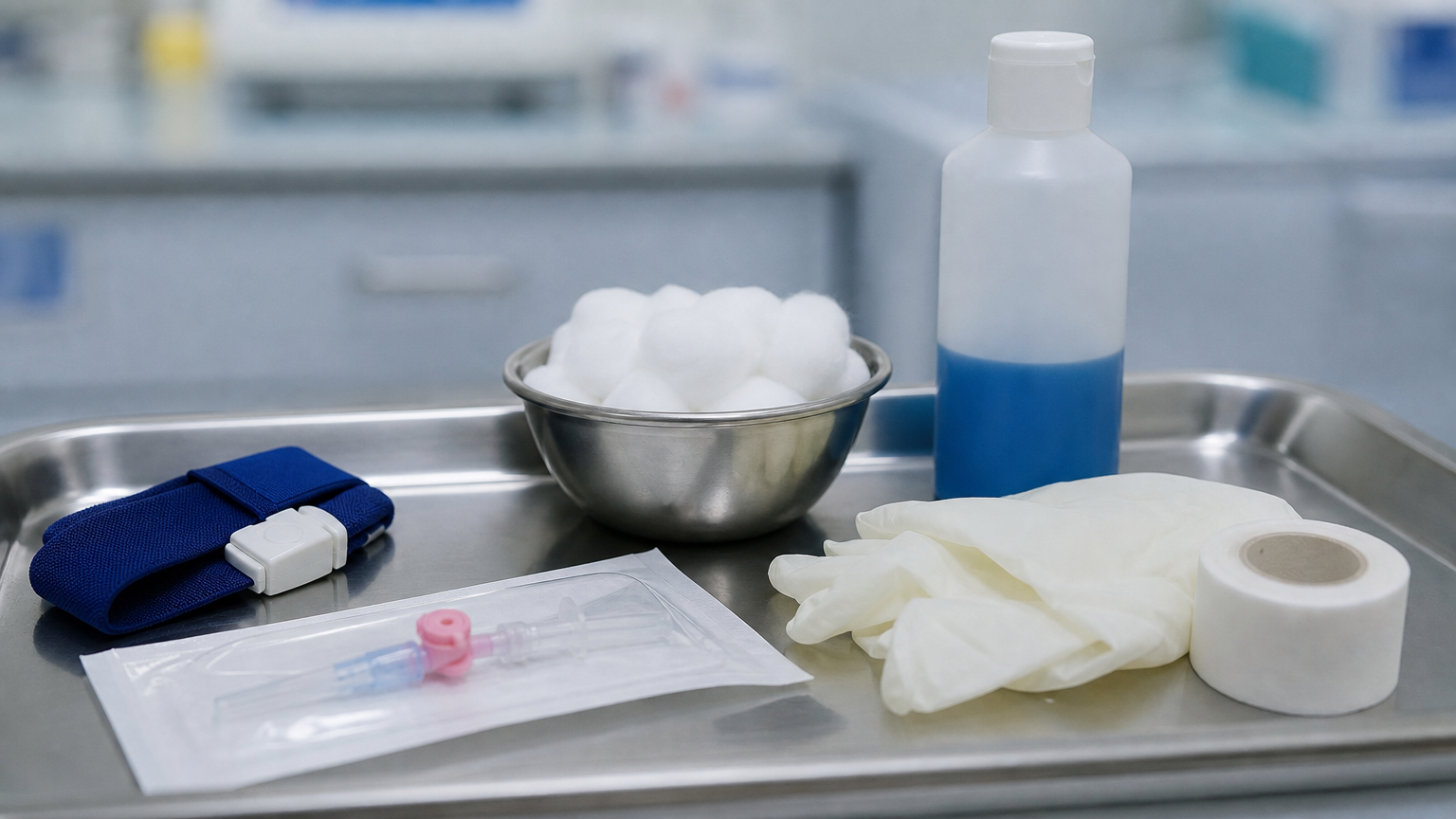
Peripheral venous access — known in Brazil as punção venosa, and used to draw blood and to give medicines and intravenous fluids — is one of the techniques most often performed in hospitals, clinics and laboratories. It is also a technique that demands precision: a poorly placed line can cause bruising, infection or the need to repeat the procedure, adding to the patient's discomfort. That is why a course like this one, aimed at refining technique, has a direct effect on the quality of care.
IV cannulation is not the same as a blood draw
This is one of the most common confusions among people starting to study the subject. A blood draw is a one-off procedure: the needle goes in, takes the sample for testing and comes out. Peripheral IV cannulation, the focus of the course, places a flexible catheter in the vein, creating access that can stay in place for days to give fluids and medication. The purposes are different, and so are the materials: rigid winged needles (the "butterflies") suit quick, single draws, while flexible catheters are made to stay in place longer, with less trauma to the vessel. Understanding this difference from the start avoids choosing the wrong material, and it is one of the first points the course clears up.
A routine technique that demands skill, not improvisation
Contrary to how it may look from the outside, venous access involves knowledge of vascular anatomy, the right choice of material, proper preparation of the patient and strict biosafety. It is the combination of these factors that reduces complications and makes the procedure safer both for the person performing it and for the person receiving it.
What the course teaches
Open to anyone with completed upper secondary schooling, with or without experience in health care, the course covers:
- Anatomy of the venous system
- Venous access techniques
- Identifying and using materials
- Preparing the patient
- Preventing complications, such as phlebitis (inflammation of the vein), infiltration/extravasation (when fluid escapes into the tissue around the vessel) and local infection
- Infection control
- Biosafety
- Good practice in health services
It is an 8-hour in-person course, with an emphasis on supervised practice — the right format for a technique that depends on guided repetition to build confidence.
Why supervised practice makes a difference
People learning this technique usually carry two very concrete fears: the fear of hurting the patient, and uncertainty at the exact moment of the procedure — recognising the right signs and knowing what to do next. These are not unusual fears, and they are not overcome by reading about the subject: they are overcome by repeating the movement under supervision, in a controlled setting, until uncertainty gives way to confidence. That is exactly the role of the course's practical hours.
Who benefits most
The course is open to anyone with completed upper secondary schooling, with no prior training in health care required. It is especially useful for students and professionals who are already in contact with clinical routine and want to refine this technical skill — people who work, or will work, in hospitals, clinics, laboratories, health units and blood collection services. It also helps professionals see more clearly the scope of practice of each category, always in light of the current resolutions of Brazil's Federal Nursing Council (Cofen). More complex procedures follow specific rules, which are worth checking case by case. For anyone who also wants to be ready for the most serious emergencies in clinical routine, the Basic Life Support course is a natural complement.
The course at the Brazilian Red Cross — Rio de Janeiro Branch
The branch's Escola de Educação e Saúde CVB-RJ (School of Education and Health) runs the Peripheral IV Cannulation course (Punção Venosa, in Portuguese):
- Hours: 8
- Minimum schooling: completed upper secondary (ensino médio)
- Format: in person, with supervised practice
- Language: Portuguese — there is no interpreting or group in another language
- Who it is for: anyone with completed upper secondary schooling; especially useful for health students and professionals
- Certificate: issued by the Brazilian Red Cross — Rio de Janeiro Branch at the end of the course
Frequently asked questions
Is the course about drawing blood? Not mainly. A blood draw is a quick procedure, only to take a sample for testing. The course focuses on peripheral IV cannulation: placing a catheter that stays in the vein for continuous use, such as giving fluids and medicines.
Is this course suitable for someone who has never worked in health care? Yes. It is open to anyone with completed upper secondary schooling, with no prior training in health care required. Performing the procedure on patients at work follows the rules of each person's profession.
Is the course theory only? No. The 8 hours combine theoretical grounding with supervised practice, essential for developing the technique safely.
Does the course material teach the insertion technique step by step, like a video? The theory covers the fundamentals, but the technique itself (needle angle, recognising the right signs, advancing the catheter) is practised in person, under direct supervision. This kind of learning cannot be passed on safely through text or video, which is why in-person practice is central to the course.
What schooling is required? Completed upper secondary schooling.
Which complications does the course teach you to prevent? Phlebitis (inflammation of the vein), infiltration or extravasation (when fluid leaves the vessel for the surrounding tissue) and local infection from lapses in antisepsis are the most common complications covered.
Can nursing technicians and nurses perform the same kinds of venous access? There are differences in scope of practice set by Cofen, especially for more complex access (such as central lines or devices like the PICC). The course presents these distinctions in general terms, but each professional should confirm their exact scope in the council's current resolutions.
Sources and references
- Cofen — Legislation — official reference on the scope of practice of nursing technicians and nurses in Brazil, in Portuguese.
First published in Portuguese on 24 September 2026. Read the original →