
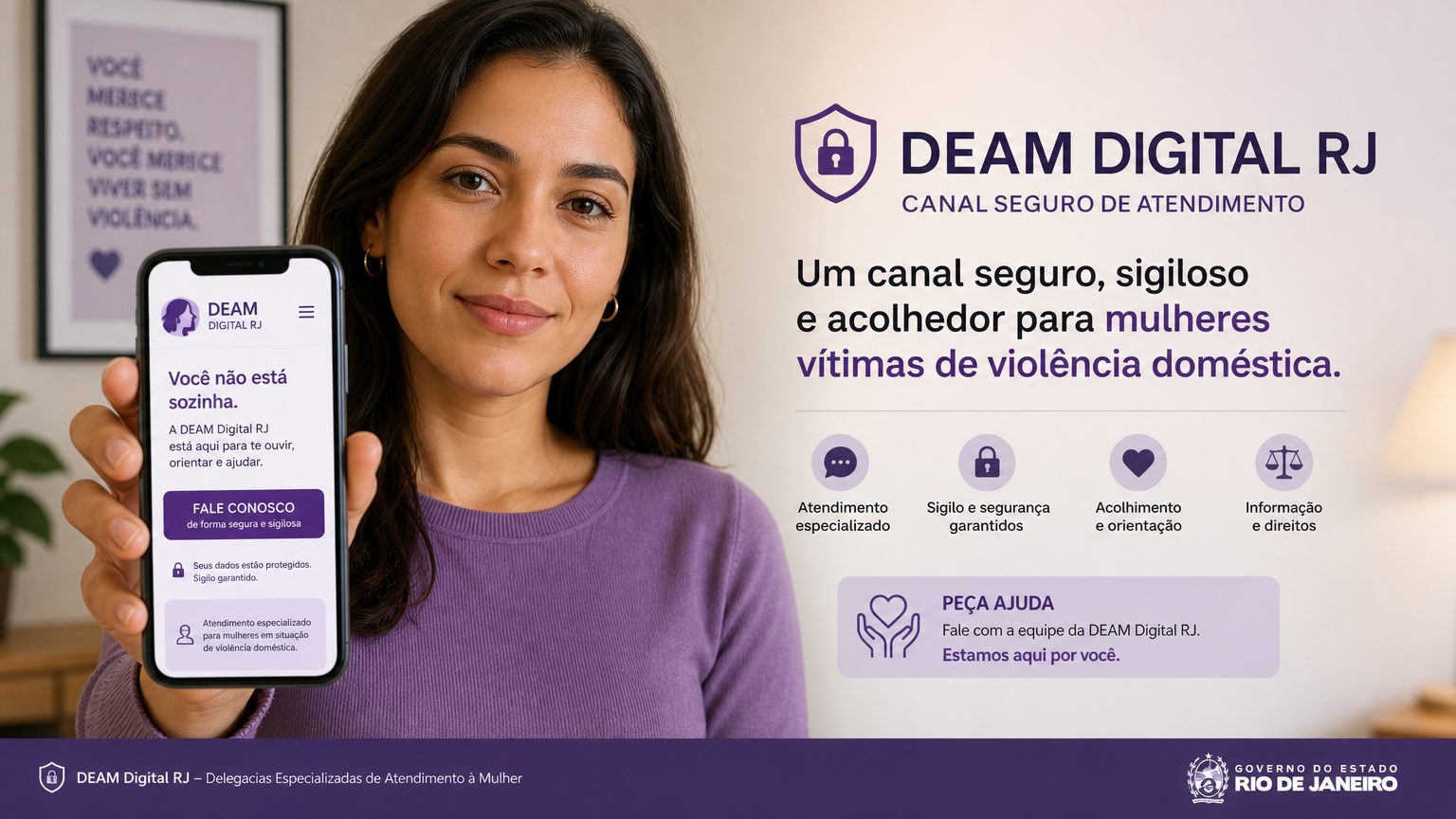
Victims of domestic violence in Rio de Janeiro can report it without leaving home. The channel is the Delegacia Especial de Atendimento à Mulher (Deam Digital), the Special Police Station for Women, a virtual unit of the Rio de Janeiro State Civil Police. The service is provided remotely, quickly and safely. There is no need to go to a physical police station first to file the report.
Deam Digital is part of the Civil Police's state network of specialised services, made up of police stations for women across the state. The virtual unit does not replace those stations: it works as a way in, shortening the path between the moment a woman decides to report and the start of the investigation.
Who it is for
The service is for women who suffer violence at the hands of a partner, former partner, family member or anyone with whom they have a domestic, family or intimate relationship. Domestic violence is not limited to physical assault. Threats, stalking, constant humiliation, control over money and documents, destruction of property and sexual violence within the relationship are also forms of violence.
The channel is particularly useful for women who find it hard to travel — because of a lack of transport, because they live in a municipality far from a specialised police station, for health reasons, or because they cannot leave home without the abuser noticing. Third parties who witness the situation, such as neighbours and relatives, can also alert the authorities.
What to do
- If there is immediate danger, first get to a safe place and call the police by phone. The online report is for situations where no emergency is under way.
- Go to the Special Police Station for Women (Deam Digital) page on the Rio de Janeiro State Civil Police website and find the reporting service.
- Have to hand an identity document, your address and the abuser's details, if you know them.
- Describe what happened in as much detail as possible: what happened, when, where and whether there were witnesses.
- Keep evidence: photographs of injuries, messages, audio recordings, screenshots of social media, medical reports and prescriptions.
- Ask for urgent protective measures when you file the report, such as removing the abuser from the home and banning them from approaching or contacting you.
- Note down the report number and follow its progress. If you are asked to attend a police unit, go.
- File the report on a safe device and, if possible, clear the browsing history afterwards.
What to avoid: do not confront the abuser to obtain evidence, do not say you are going to report before you are somewhere safe, and do not throw away messages or objects that could prove the abuse. Reporting does not oblige a woman to make any other immediate decision about the relationship — legal protection exists regardless.
Where to find help or learn more
Besides the police, the protection network includes health units, the social assistance reference centres (CRAS and CREAS), the Public Defender's Office, the Public Prosecutor's Office and the guardianship councils, when children and adolescents are involved. In cases of sexual violence, go to a health service immediately: care is the victim's right and does not depend on a police report.
The Brazilian Red Cross — Rio de Janeiro Branch works to protect people in vulnerable situations, following the principles of humanity, impartiality and neutrality of the International Red Cross and Red Crescent Movement. The branch also works on suicide prevention and mental health, a subject covered in the article on Yellow September — psychological distress and domestic violence often go hand in hand.
For anyone who wants to be ready to help and guide others, the branch offers in-person courses, taught in Portuguese. Other public-interest guidance is collected in the news section.
Based on information from Agência Brasil (human rights section), published on 27 August 2026 — original report, in Portuguese.

First published in Portuguese on 3 September 2026. Read the original →