
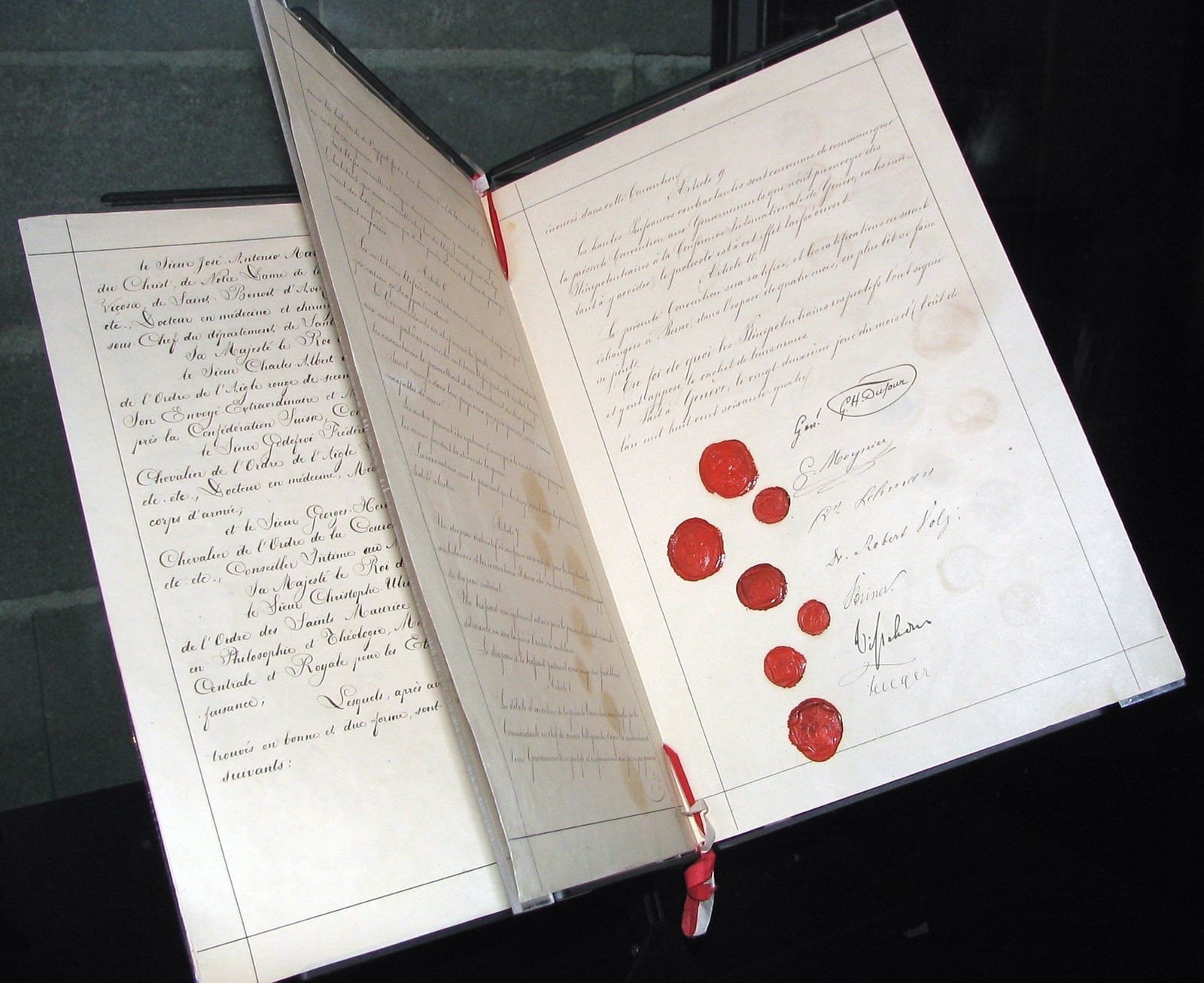
The Geneva Conventions are international treaties containing the most important rules for limiting the effects of armed conflict. The four Conventions in force were signed on 12 August 1949. They protect people who are not taking part in the hostilities, such as civilians, health workers and humanitarian workers, and people who are no longer taking part, such as the wounded, the sick, the shipwrecked and prisoners of war. Brazil incorporated them into its law in 1957.
What the Geneva Conventions are
According to the International Committee of the Red Cross (ICRC), the Geneva Conventions and their Additional Protocols are the core of international humanitarian law (IHL), the branch of international law that regulates the conduct of armed conflict and seeks to limit its effects.
They do not have a single origin. The first Geneva Convention dates from 1864 and was revised over time. The 1949 texts revised, for example, the 1929 Convention on the wounded and sick. That is why people speak of "Conventions", in the plural, and always with the year: the set in force today is the one from 1949. For the story that led to the first treaty, read who founded the Red Cross.
How many there are and who each one protects
There are four Conventions, all dated 12 August 1949. Each one covers a group of people:
- First Convention: wounded and sick members of the armed forces in the field.
- Second Convention: wounded, sick and shipwrecked members of the armed forces at sea.
- Third Convention: prisoners of war.
- Fourth Convention: civilians in time of war.
The texts also protect medical duties, health personnel and facilities, and medical transport. Each Convention has its own focus, and together they cover the main groups of people affected by armed conflict.
Common Article 3
All four Conventions share an identical article, Article 3, known as "common Article 3". It sets minimum rules for armed conflicts that take place within a single country. It states that people taking no active part in the hostilities, including members of armed forces who have laid down their arms, shall in all circumstances be treated humanely.
What happens when the rules are broken
The Conventions do more than list rights. According to the ICRC, they set out measures to prevent or put an end to all violations, and they contain strict rules for what are called "grave breaches". Those responsible for grave breaches must be searched for and tried or extradited, whatever their nationality. The rule applies to every State party to the treaties, on every side.
The Additional Protocols
According to the ICRC factsheet on the Additional Protocols, the 1949 Conventions left gaps on important points, such as the protection of the civilian population against the effects of hostilities. To fill them, two Additional Protocols were adopted in 1977 and a third in 2005. They supplement the Conventions; they do not replace them.

How Brazil incorporated the Conventions
In Brazil, the path was the same as for any treaty. The National Congress approved the four Conventions through Legislative Decree No. 35 of 12 September 1956, as recorded in Decree No. 42,121 (in Portuguese). Brazil ratified them by letter of 14 May 1957, and the instrument of ratification was deposited with the Swiss government, in Bern, on 29 June 1957.
On 21 August 1957, Decree No. 42,121 promulgated the Conventions and ordered that they be carried out and complied with in full. That decree contains the official text in Portuguese. The ICRC, for its part, states that these treaties are universally accepted, and in August 2024 the ICRC's Cross-Files blog also described the 1949 Conventions as "universally ratified".
The role of the Red Cross
The link between the Red Cross and these treaties goes back to the beginning: the first Geneva Convention, of 1864, grew out of the ideas that founded the Movement, and the ICRC has a recognised role in promoting international humanitarian law. To see how the Movement is organised, read what the ICRC is.
Frequently asked questions
How many Geneva Conventions are there? Four, all signed in Geneva on 12 August 1949. They are supplemented by Additional Protocols adopted in 1977 and 2005.
Who do the Geneva Conventions protect? People who are not taking part in the hostilities (civilians, health workers and humanitarian workers) and people who are no longer taking part (the wounded, the sick, the shipwrecked and prisoners of war), according to the ICRC.
Did Brazil adopt the Geneva Conventions? Yes. Congress approved them in 1956, Brazil ratified them in 1957, and they were promulgated by Decree No. 42,121 of 21 August 1957.
What is the difference between the Geneva Conventions and international humanitarian law? The Conventions are the central treaties of IHL. IHL is the wider body of rules governing armed conflict, which includes the Conventions, their Protocols, other treaties and customary law.
Sources and references
- Geneva Conventions and the law — ICRC (in Portuguese): core of IHL, the 1949 Conventions and Protocols, who is protected, grave breaches. Checked on 15/10/2026.
- 1977 Additional Protocols to the Geneva Conventions of 1949 — ICRC: universally accepted treaties, gaps in the Conventions, the 1977 and 2005 Protocols. Checked on 15/10/2026.
- Decree No. 42,121 of 21 August 1957 — Brazilian Presidency (in Portuguese): promulgation of the four Conventions, Legislative Decree No. 35/1956, ratification and deposit in 1957, common Article 3. Checked on 15/10/2026.
- The 1949 Geneva Conventions: a primer — Cross-Files, ICRC blog (7/8/2024): "now universally ratified". Checked on 18/10/2026.
First published in Portuguese on 19 October 2026. Read the original →